
The goals of our ecological stewardship program at ruthven park…
-
Study
To develop a greater understanding of the interdependence between humans and nature through our own and partnered ecological research projects.
-
Protect
To preserve native species and their biological communities through our ongoing conservation efforts.
-
Educate
To enlighten guests to the wonder of our natural environment and the importance of the biodiversity within and beyond Ruthven Park.

“understanding of the natural world is a source of not only great curiosity, but great fulfilment."
-Sir David Attenborough
Current ecological stewardship projects:
Bird banding
Wetland studies
Invasive species removal
Tree surveys
Habitat restoration
Species census collection
Spotlight on Butterfly Meadow
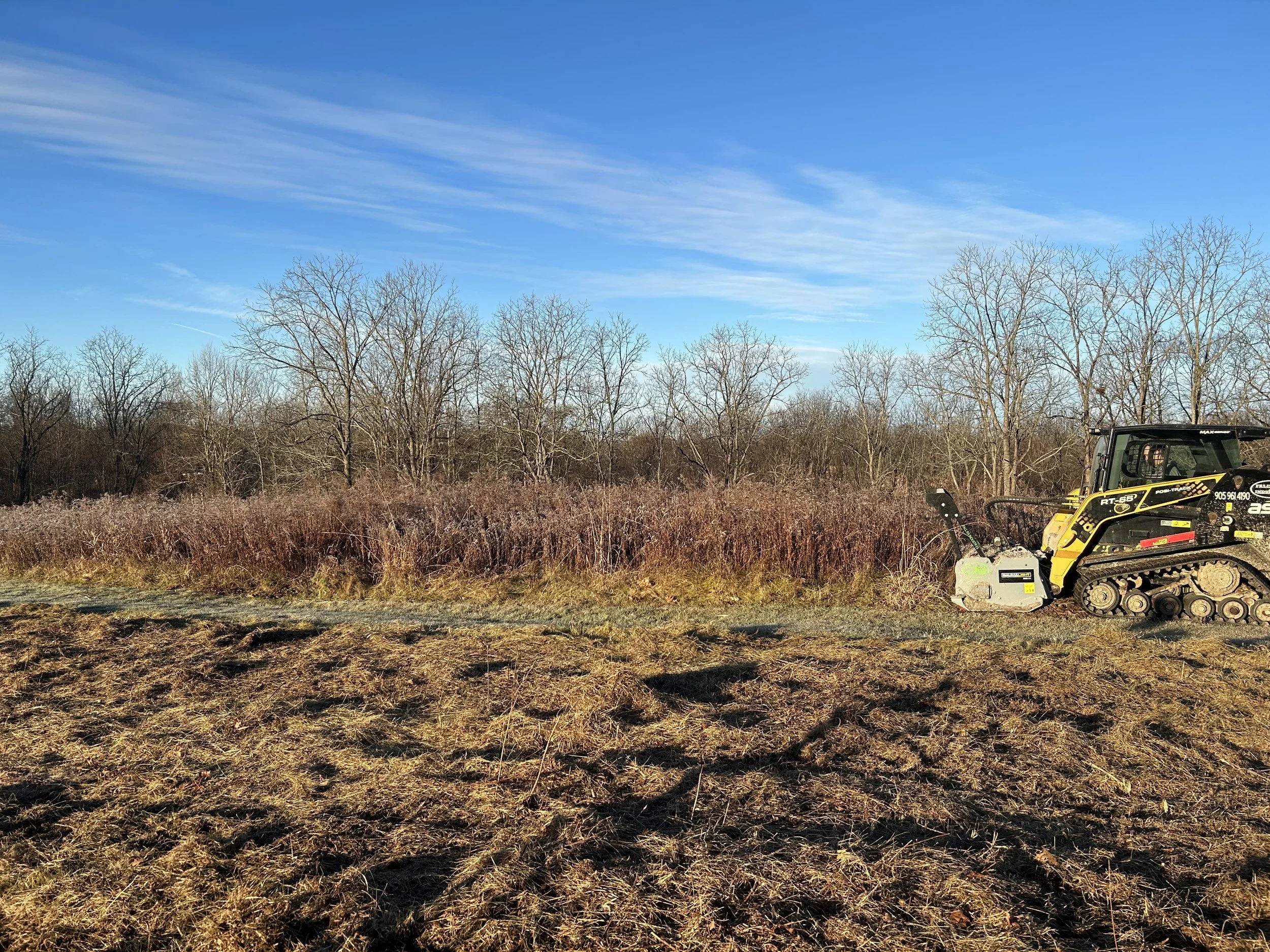

In our ongoing stewardship efforts at Ruthven Park we are consistently working to combat non-native, predatory, and invasive species. Several methods are used including: manual pulling, chemical treatment, prescribed burning, and mowing. Most recently we embarked on the last option with the assistance of Alex’s Eves and Siding. We tasked Alex with using his forestry mulching equipment to clear our Butterfly Meadow area and he was certainly up for the task.
Meadows are a stage of natural succession and if left alone will eventually turn back into forested areas. Mowing like this can be used to help manage the takeover of woody stemmed plants, such as Dogwood and Black Walnut. Thus, to preserve the meadow as it stands, management like mowing or burning must be done. Mowing removes the predatory species and encourages the native species to come up instead.
This process is a cyclical one with mowing occurring approximately every two years.
We are very grateful for the work that Alex put in and we are eagerly anticipating the return of the beautiful native wildflowers this spring!
This project was made possible by funding received from the Grand River Conservation Foundation. Thank you!
Species of the Month
January’s article written by Brian Pomfret, Master Bird Bander at Ruthven Park National Historic Site
(Originally published in November 2023)
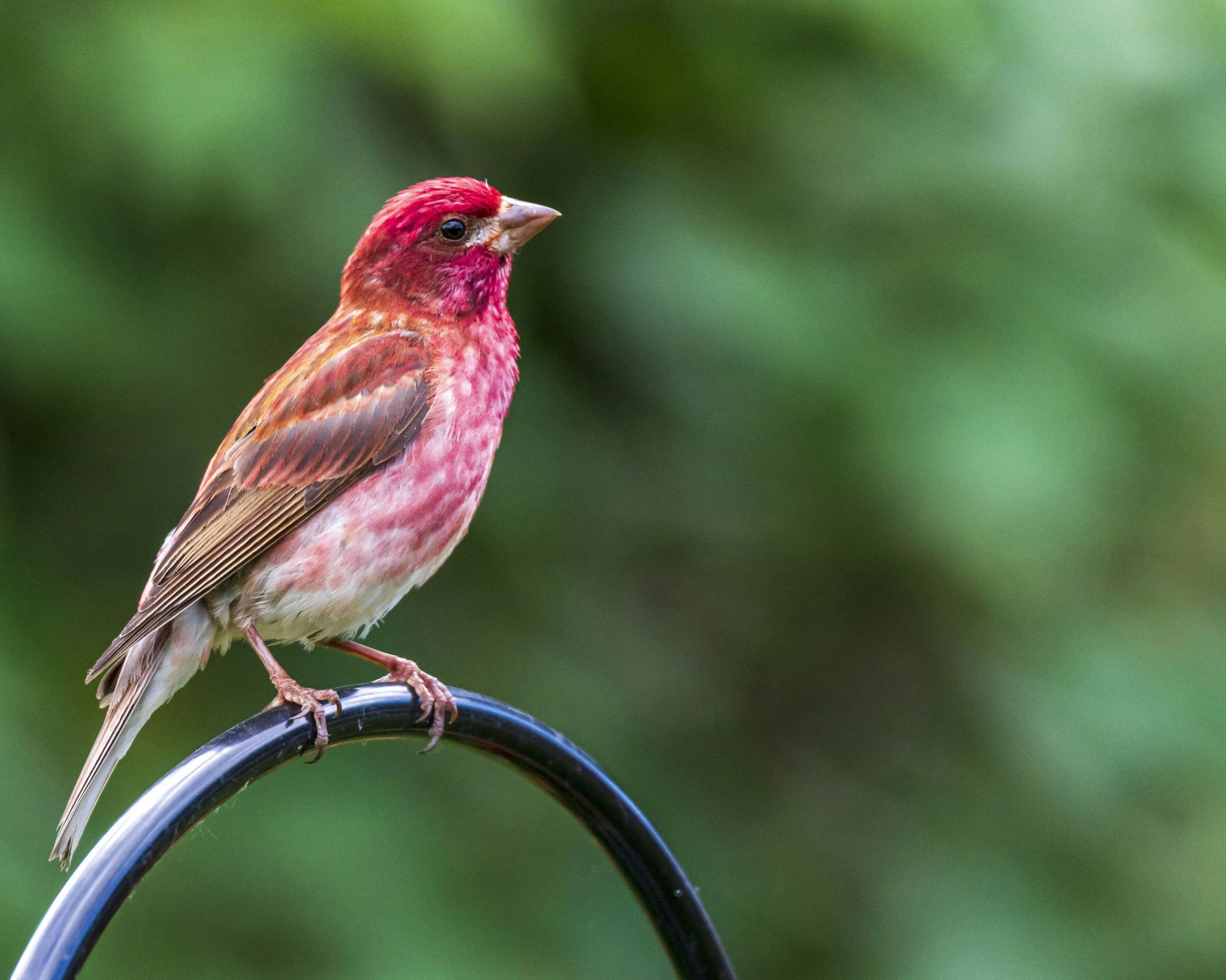
Purple finch
Haemorhous purpureus
In November the cold of approaching winter is foreshadowed through more common overnight frosts. Neotropical migrant species of bird have arrived at – or are quickly approaching – their overwintering sites in warmer climes, and short distance migrants have mostly departed our area. November is the month when species of bird that overwinter in southern Ontario arrive, and the composition of bird communities found at backyard bird feeders show evidence of change.
The Purple Finch (Haemorhous purpereus) is an example of a short distance migrant that can be found in southern Ontario in November that frequently overwinters. They breed in coniferous and mixed coniferous/deciduous forests across Canada, and along the Pacific coast of the United States. The northern population of Purple Finch typically migrate to the southeastern United States while southern populations remain in place. However, the migration of Purple Finches is tied to the abundance of the cone crops of the conifers in the forests in which they live. Populations of Purple Finch in areas with a poor cone crop will move to areas where cones are more abundant, while others in areas with abundant cones stay throughout the winter.
The Purple Finch weighs between 18 and 32g, is approximately 14cm in length, and has a wingspan of between 22 and 26cm. Despite the name, neither the male nor female Purple Finch is actually purple. Males are raspberry red, or old rose, in colour on their upper parts, while females are streaky brown in appearance and have a broad white stripe above their eyes. Both genders have whitish, streaked, underparts. The tail of the Purple Finch is short with a distinct fork when at rest, and the beak is large, powerful, and conical in shape.

In the summer months Purple Finch can be found foraging in the forest canopy, feeding on the seeds of conifers, elms (Ulmus spp.), maples (Acer spp.), and others, on soft buds, and upon nectar, obtained through biting the base off of nectar laden flowers. Berries are also eaten, typically blackberries (Rubus spp.), juniper (Juniperus spp.), and poison ivy (Toxicodendron spp.), along with caterpillars, aphids, and beetles.
The nest of the Purple Finch is an open cup made of twigs and roots situated on a horizontal branch. The cup is lined with various grasses, moss, and hair. In the northern part of their range the nest is typically located in a conifer, while in the south deciduous is preferred.
During the winter Purple Finch can be found in shrublands, old fields, and forest edges. They often come to the ground to feed on seeds from plants and stalks found in weedy fields. Purple Finch will utilize bird feeders, preferring black oil sunflower seeds, millet, and thistle seeds. They will perch on various types of feeders, or feed on the ground on spilled, or otherwise broadcast, seed.
The eastern population of Purple Finch has been undergoing a gradual decline over the past few decades. The reason for this decline is thought to be competition with the more aggressive, introduced, House Finch (H. mexicanus), a species that originated in western North America. The decline is not considered alarming however and the Purple Finch is of low conservation concern.
During fall migration, and throughout suitable winters, look for Purple Finch at the feeder stations at Ruthven Park, and along the Grand River Trail, and trails through the Butterfly Meadow.